
Best Sustainable Clothing for Women: Buying Guide

Table of Contents
- What Makes Clothing Truly Sustainable for Women
- Sustainable Clothing Materials: What to Look For
- How to Identify Ethical Clothing Brands for Women
- Is Affordable Sustainable Clothing Actually Possible?
- Sustainable Wardrobe Essentials That Earn Their Place
- Sizing, Fit, and Care: What to Check Before You Buy
- Conclusion
- Frequently Asked Questions
Last Updated: October 16, 2026
What Makes Clothing Truly Sustainable for Women
The global sustainable fashion market is projected to grow from US$12.44 billion in 2026 to US$27.96 billion by 2034, according to Fortune Business Insights' sustainable fashion market forecast.
Sustainable clothing is apparel designed, produced, and sold in a way that reduces environmental harm and respects the people who make it. That definition sounds simple.
A 2024 study indexed by PubMed Central on perceived sustainability and clothing decisions found that how consumers perceive a garment's sustainability directly shapes what they buy.
Four Criteria That Separate Real Claims From Marketing
Judging a brand comes down to four questions. Ask them in order, and most weak claims fall apart by question two.
- Materials: Are the fibers organic, recycled, or regenerated, and can the brand name them specifically?
- Labor: Does the brand disclose who makes the clothes and under what conditions?
- Transparency: Can you trace a garment from fiber to finished piece, or is "eco-friendly" just a tagline?
A 2022 case study in Sustainability journal's study of Donegood's core values examined ten stated sustainable-fashion values, including eco-friendliness, worker empowerment, organic materials, and recycled or upcycled products. The lesson: values are easy to list. Verification is the hard part.
Sustainable Clothing Materials: What to Look For
The fiber is the biggest lever on a garment's environmental footprint and the easiest thing to check. Start with the label.
Natural fabrics like organic cotton, linen, hemp, and wool break down more easily than synthetics. Regenerated fibers like TENCEL lyocell and bamboo are made by processing plant pulp, often in a closed-loop system that recovers the solvent. Recycled materials, including recycled polyester, give existing plastic a second life.
The 2024 PubMed Central study identified organic cotton, recycled polyester, linen, and wool as common sustainable-fashion materials, and a 2026 trends report from Project Cece's sustainable fashion predictions flags a growing preference for natural, safer materials.
Natural Fabrics and Regenerated Fibers Compared
| Material | Source | Best For | Watch For |
|---|---|---|---|
| Organic cotton | Organic farming, no synthetic pesticides | Everyday basics, tees | "Cotton" alone is not organic |
| Linen | Flax plant | Summer clothing, breathable layers | Wrinkles easily |
| Hemp | Cannabis sativa plant | Durable staples | Rougher initial feel |
| TENCEL lyocell | Wood pulp, closed-loop | Draped tops, dresses | Higher price point |
| Recycled polyester | Post-consumer plastic | Activewear, outerwear | Still sheds microfibers |
| Wool | Sheep fleece | Warmth, year-round tailoring | Check for ethical sourcing |
"Natural" and "sustainable" are not synonyms: conventional cotton is one of the thirstiest crops grown, and organic farming changes that equation. Certification matters as much as the fiber name.
How to Identify Ethical Clothing Brands for Women
Identifying ethical clothing brands for women means checking two things: third-party certifications and how much of the supply chain the brand will show you. A hangtag logo proves nothing; a published factory list and a named certification do.
Certifications worth recognizing include GOTS for organic textiles, Fair Trade for labor standards, and OEKO-TEX for chemical safety. None guarantees perfection, but each requires independent auditing a marketing department cannot fake.
Certifications and Supply Chain Transparency
Ask three questions before you trust a claim:
- Which certification covers this specific garment, not the brand overall?
- Does the brand publish its supplier or factory list?
- Can the brand explain how a fiber moved from farm to finished piece?
If a brand dodges any of these, treat the sustainability claim as unproven.
Is Affordable Sustainable Clothing Actually Possible?
Yes, but not the way fast fashion taught you to shop. Affordable sustainable clothing rarely means the lowest sticker price. It means the lowest cost per wear over the life of the garment, and the lowest total spend across a wardrobe you actually wear.
Fast fashion has defined "affordable" for a generation: a CAD $15 top feels cheap until it pills after three washes and gets tossed.
What Sustainable Women's Clothing Actually Costs in Canada
Prices vary by category and by how much of the supply chain a brand controls. Based on typical retail pricing at Canadian sustainable and ethical women's brands, here is the range to expect:
| Category | Fast-fashion equivalent | Mid-tier sustainable | Premium sustainable |
|---|---|---|---|
| T-shirt or basic top | CAD $10-$20 | CAD $45-$80 | CAD $90-$140 |
| Button-down or blouse | CAD $25-$40 | CAD $80-$140 | CAD $150-$250 |
| Denim jeans | CAD $30-$60 | CAD $110-$180 | CAD $200-$320 |
| Day dress | CAD $35-$70 | CAD $120-$220 | CAD $240-$400 |
| Blazer or tailored jacket | CAD $60-$120 | CAD $180-$320 | CAD $350-$600 |
| Knit sweater | CAD $30-$60 | CAD $100-$180 | CAD $200-$350 |
| Wool or wool-blend coat | CAD $100-$200 | CAD $300-$550 | CAD $600-$1,200 |
Those ranges are a useful reality check. If a brand claims GOTS-certified organic cotton and ethical labor and sells a button-down for CAD $22, someone in the supply chain, usually the worker or the environment, is subsidizing it. If a brand charges CAD $400 for a basic tee, you are paying for positioning as much as materials.
Cost-Per-Wear: The Number That Matters Most
Cost-per-wear is the purchase price divided by the number of times you actually wear the item. It is the most useful number in a sustainable wardrobe, because it converts a sticker price into a real cost.
| Garment | Price | Wears per year | Years worn | Total wears | Cost per wear |
|---|---|---|---|---|---|
| Fast-fashion top | CAD $30 | 8 | 0.5 | 4 | CAD $7.50 |
| Mid-tier organic cotton tee | CAD $60 | 30 | 3 | 90 | CAD $0.67 |
| Tailored blazer | CAD $220 | 50 | 5 | 250 | CAD $0.88 |
| Wool coat | CAD $450 | 90 | 8 | 720 | CAD $0.63 |
| Trend dress | CAD $140 | 5 | 1 | 5 | CAD $28.00 |
The pattern is consistent: the pieces you wear most often and keep longest win on cost per wear, even at three to five times the upfront price.
How to Make Sustainable Clothing Affordable in Practice
A few practical moves bring sustainable clothing within reach without compromising on the criteria that matter:
- Buy fewer, better pieces. A capsule of 30 well-chosen items typically outperforms a closet of 100 impulse buys on both cost per wear and total spend.
- Use installment payments where offered. Splitting a CAD $220 blazer into four interest-free payments turns a single large purchase into a manageable monthly cost. Pink Martini Collection offers interest-free installment options for exactly this reason.
- Shop resale first for statement and trend pieces. A second-hand dress at CAD $40 has a fraction of the embodied carbon of a new one, and it is often the same garment.
The Second-Hand Baseline
Lifecycle research commonly finds that the most eco-friendly way to shop may be not to buy new at all. Second-hand or rewearing what you own can beat buying new, even new "sustainable" pieces, because most of a garment's environmental impact happens before it reaches you. The best sustainable purchase is often the one you do not make, and the second best is the one you will still be wearing in five years.
Sustainable Wardrobe Essentials That Earn Their Place
The best sustainable wardrobe essentials are the pieces you reach for constantly, not the ones that look good on a hanger. Build around versatility, and you buy less overall.
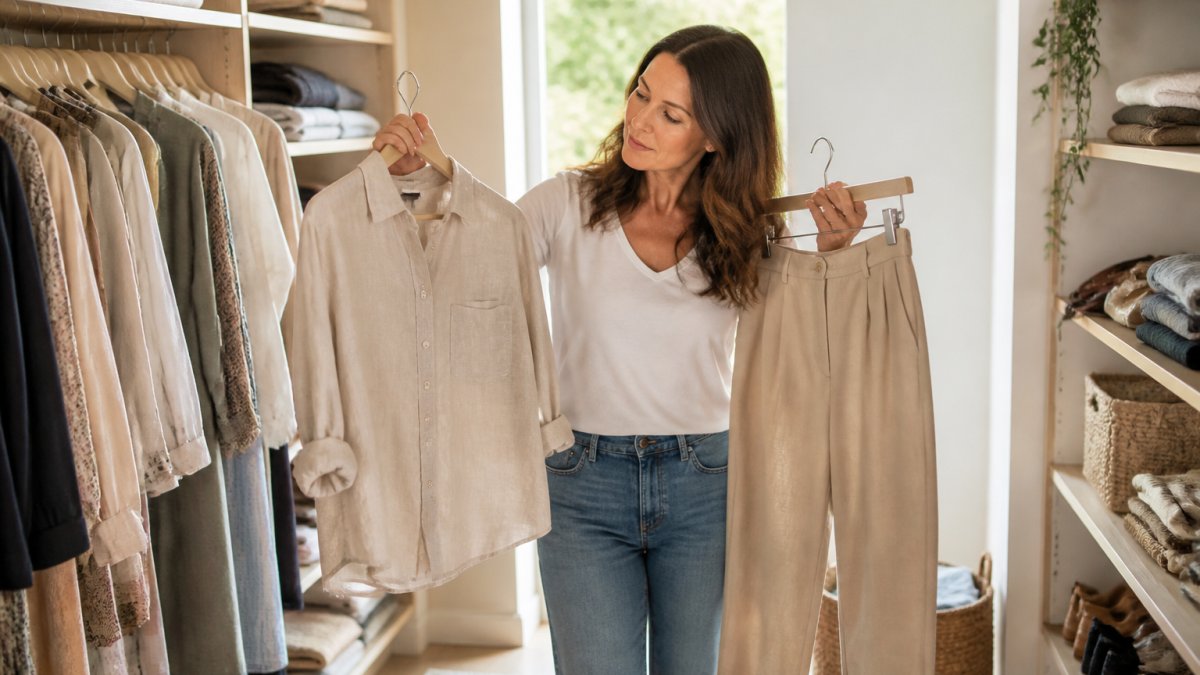
Start with a short list:
- A neutral linen or organic cotton blouse that works under a blazer or on its own
- Tailored trousers in a mid-weight fabric that holds its shape
- A versatile dress that transitions from day to evening
That last item matters more than it sounds. Project Cece's 2026 trends report lists "individual style over trends" as a defining shift, aligning with slow fashion's core idea: buy pieces you will still want in five years.
Sizing, Fit, and Care: What to Check Before You Buy
Fit and care determine whether a garment actually gets worn, which makes them sustainability issues, not just shopping preferences. A piece that does not fit or is too fussy to maintain ends up unworn, and unworn clothing is waste, regardless of the fiber.
Most sustainable-clothing roundups stop at brand recommendations and never explain how to check whether a brand's sizing will work for your body, or what to do with a garment once it wears out.
Size Ranges: What to Compare Before You Buy
Size inclusivity is where many sustainable brands fall short. A brand that markets itself as "inclusive" but stops at a size 12 is not inclusive for most women. Before you fall in love with a photo, check the size chart and the actual range offered.
| Size tier | Typical range offered | What to check |
|---|---|---|
| Narrow | XS-L (approx. 0-12) | Whether the brand calls itself inclusive, it is not |
| Standard extended | XS-XXL (approx. 0-18) | Whether the XXL is a true fit or a scaled-up small |
| Inclusive | XS-4XL or 0-28+ | Whether fit is graded on real bodies or mathematically scaled |
| True extended | 00-32+ with petite, tall, and curvy fits | Whether the brand publishes separate fit blocks |
A few practical checks that save returns and wasted shipping:
- Look for body measurements, not just letter sizes. A brand that lists bust, waist, and hip in centimeters or inches is easier to fit than one that only says "size M."
- Check whether the brand offers petite, tall, or curvy fits. A single fit block scaled up and down fits fewer bodies well.
- Read the return policy before ordering. Sustainable brands often have narrower return windows than fast fashion, and return shipping is sometimes at your cost.
Pink Martini Collection celebrates diverse body types and personal styles, and our 995+ customer reviews repeatedly mention quality and value, with shoppers noting the selection and the shopping experience.
Care: The Habits That Extend a Garment's Life
How you wash and store a garment affects its lifespan more than almost anything else. A few habits make the difference:
- Wash less often. Most garments do not need washing after every wear. Air them out between wears and spot-clean where possible.
- Wash cold and on a gentle cycle. Heat is the enemy of natural fibers and of the dyes in them.
- Use a mesh laundry bag for knits and delicates. It prevents stretching and pilling.
A quick pre-purchase checklist:
- Does the size chart actually include your size, with measurements?
- Is the fabric low-maintenance or does it demand dry cleaning?
- Will this piece work for at least three outfits you already own?
Repair, Resale, and End of Life
The most sustainable garment is the one that stays in use. When a piece wears out, keep it out of landfill as long as possible. In order of preference:
- Repair. A dropped hem, a loose button, or a split seam is a 15-minute fix at a tailor, often for CAD $10-$30. Many cities have repair cafés where volunteers fix clothing for free.
- Alter. A garment that no longer fits can often be taken in, shortened, or restyled for a fraction of the cost of replacing it.
- Resell. Consignment and online resale platforms let you recover part of the purchase price and pass the garment to someone who will wear it.
- Swap. Clothing swaps with friends or community groups keep garments in circulation at no cost.
- Donate responsibly. Only donate garments that are clean and wearable. Torn or stained items usually end up as textile waste, not as clothing for someone in need.
- Recycle as a last resort. Textile recycling accepts worn-out garments and turns them into insulation, rags, or new fiber, but it is the least valuable end of the lifecycle.
Before you buy, ask the brand two questions: does it offer repairs or take-back, and does it publish what happens to returned or worn items? Brands that can answer are usually the ones whose sustainability claims hold up over the garment's full life.
Conclusion
Building a genuinely sustainable wardrobe takes more work than trusting a hangtag, and the payoff is a closet full of pieces you actually wear. Start with materials you can name, certifications you can verify, and cost-per-wear math that keeps you honest. Pink Martini Collection designs feminine, boho-chic pieces with sustainable materials, comfortable fits for a busy lifestyle, and versatile styling that moves from the office to an evening out.
Frequently Asked Questions
What materials are best for sustainable clothing?
Organic cotton, linen, hemp, TENCEL, and recycled polyester are among the most common sustainable clothing materials. A 2024 study indexed by PubMed Central identifies organic cotton, recycled polyester, linen, and wool as leading options. Look for certified materials where possible, since certification verifies growing and processing standards. Natural fabrics like linen and hemp also tend to be durable and breathable, which extends a garment's useful life.
How can you tell if a clothing brand is genuinely sustainable?
Check for third-party certifications, published supply chain details, and specific claims about materials and fair labor. A 2022 case study in Sustainability examined how brands like Donegood define core values such as eco-friendliness, worker empowerment, and recycled materials. Brands that name their factories, list certifications, and explain their environmental impact are easier to trust than those relying on vague language about being green or conscious.
Is ethical clothing the same as sustainable clothing?
No. Ethical clothing focuses on how workers are treated, including fair wages and safe conditions. Sustainable clothing focuses on environmental impact, such as water use, carbon footprint, and material sourcing. Many brands address both, but a garment can be made from organic cotton while still involving unfair labor. Look for evidence of both ethical manufacturing and responsible production when evaluating any brand.
How can you build a sustainable wardrobe on a budget?
Start with what you already own. National Geographic's research summary notes that the most sustainable way to dress is not to buy new things at all. When you do buy, focus on versatile sustainable wardrobe essentials you will wear weekly, compare cost-per-wear rather than sticker price, and consider second-hand or resale options first. Affordable sustainable clothing exists, but it requires patience and prioritization.


Comments